







There is a particular advantage to having watched the wheel turn enough times that you can feel what's coming before it arrives.
The young experience the Summer Solstice as pure addition. More light, more warmth, more possibility, more time. The longest day. The fullest cup. And it is all of those things — I want to say that clearly, because I remember what it felt like to stand in midsummer as a young woman and feel like the world was made of abundance and I was made to run through it. I still feel echoes of that. Standing out here at the edge of these fields in the long gold of a June evening, there's still something in me that wants to stay in it forever.
But here's what I know now that I didn't know then:
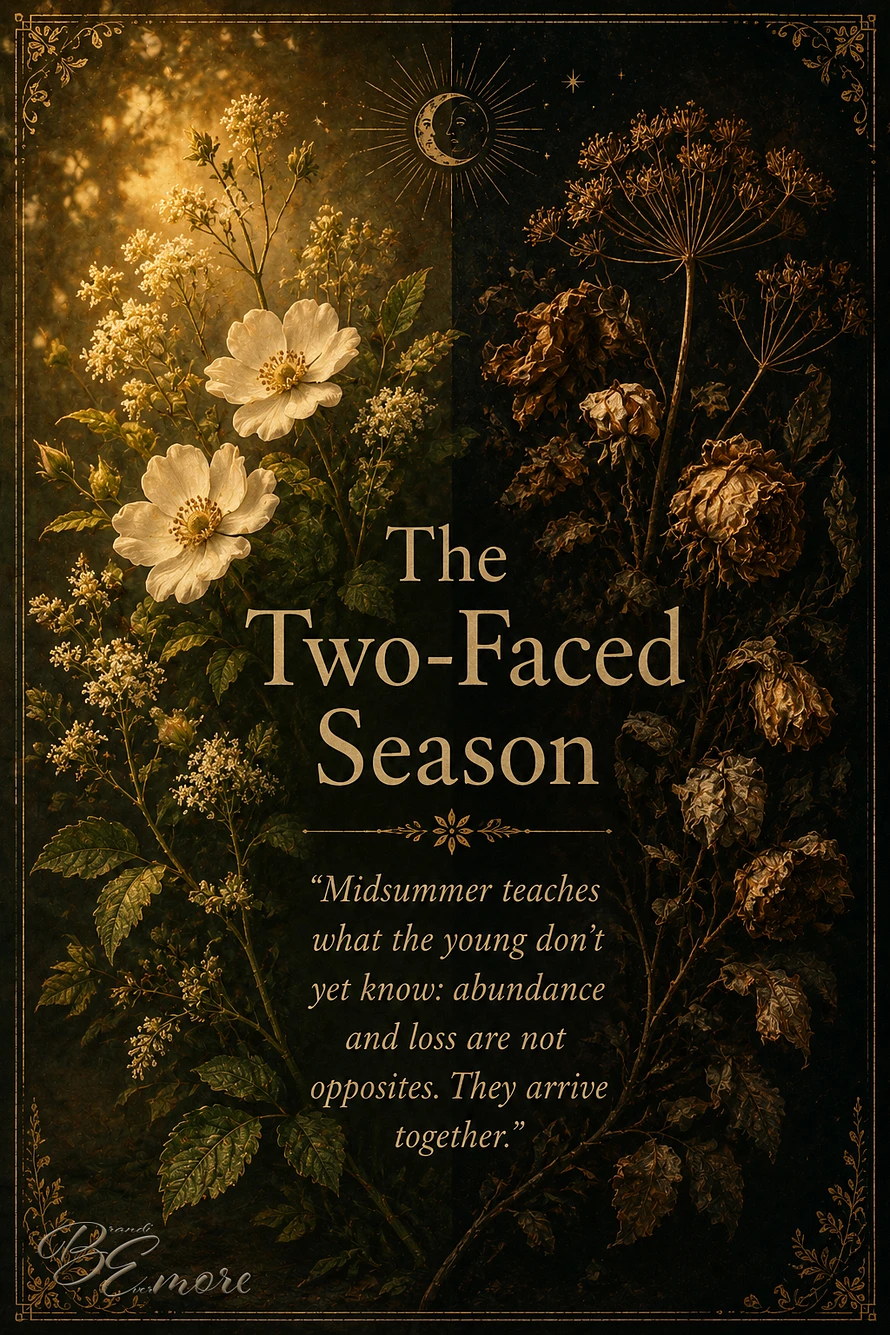
The solstice is not just the peak. It's the pivot.
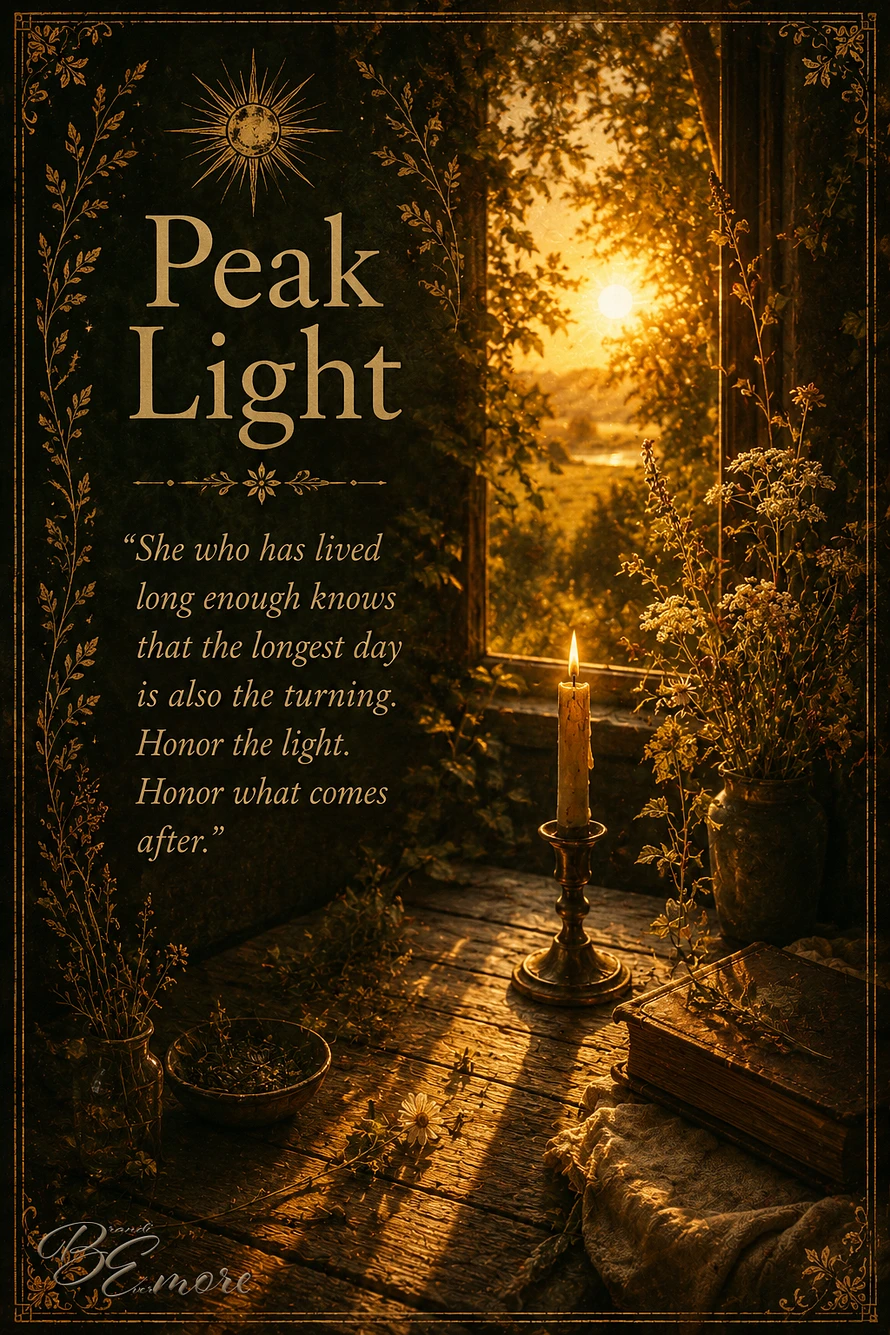
The word solstice comes from the Latin sol — sun — and sistere — to stand still. That's what the sun appears to do at the solstice. It reaches its highest point, its northernmost rising, and for a few days it seems to simply pause there. To stand in the fullness of itself before beginning its slow turn back.
I came across that years ago and it hasn't left me. The sun, at the absolute height of its power — choosing stillness before the turning.
There's something in that worth sitting with.
Everything around us pushes for more. More growth, more momentum, more output. But the solstice offers a different teaching: the peak is the moment not for acceleration, but for presence. For taking account of what you've actually grown before it begins — as it always does — to shift.
I know this in my body before I know it in my mind. I've lived through enough peaks — in seasons, in relationships, in projects, in my own bones — to have stopped fearing the turning and started using it.
When things are at their height, I don't scramble to hold them there. I ask: What is ripe here? What needs to be gathered before the wheel moves?
And this year, when I ask that question honestly, here is what answers:
This. The words. The calling that has been building in me longer than I've had language for it — to put the hard things into sentences that help another human find their way back to themselves. To healing. To peace. That is what is ripe in me right now, at this longest light. Not a side project. Not something I'll get to eventually. The thing.
Which means I also know, standing here at the pivot, what I am setting down as the light turns.
The people pleasing. The reflexive reaching for everyone else's comfort before my own. The habit — worn so deep it stopped feeling like a choice — of putting my own work, my own dreams, my own becoming on the back burner for whoever needed the front one.
I'm not setting it down because I've stopped caring about people. I'm setting it down because I finally understand that the most useful thing I have ever done for anyone is write something true. And I cannot write what's true while I'm busy managing what's comfortable.
The awareness of limitation makes things more precious, not less. When you know the long light won't last forever, you don't take it for granted. You stay up too late watching it. You notice the particular way it falls on the garden at seven in the evening in June, gold and a little amber, and you let yourself be stopped by it.
I've learned that. It took a while, but I learned it.
If I were going to offer you something to carry into this solstice — not a ritual, just an honest invitation —
Find an hour before it passes. Sit outside if you can. Let the light actually land on you. Feel the fullness of this particular moment in your actual life — not in the abstract, but in the specific and unrepeatable shape of this year.
What is ripe? What have you grown that's ready to be acknowledged, even if it isn't finished?
And then the crone's question — my question, now: What are you finally ready to set down when the light begins to shift?
You don't have to have the answer. The asking is the practice. The willingness to stand still at the peak — like the sun itself — and look both directions before you move.
The wheel is going to turn regardless.
We just have to decide what we're carrying when it does.
That image has stayed with me for years. The sun, at the height of its power, choosing to be still before the turning.
There's something in that for us.
In a culture obsessed with growth and momentum and more, the solstice offers a different teaching: the peak is the moment not for acceleration, but for stillness. For taking account. For being fully present in what is before it begins — as it always does — to shift.
What the crone knows:
She knows that every peak is also a turning. She's lived through enough of them — in seasons, in relationships, in projects, in her own body — to have stopped fearing this fact and started using it.
When things are at their height, she asks: What is ripe here? What needs to be gathered before the turn?
Not in a frantic way. Not from scarcity or fear. But with the clear eyes of someone who has learned that the harvest happens in the fullness, not in the scramble afterward.
She also knows something else — something harder to say without sounding grim, but which is actually a tremendous gift: the awareness of limitation makes things more precious, not less. When you know that the long light won't last forever, you don't take it for granted. You drink it in. You stay up too late to watch it. You notice the particular gold of it on the garden at 7pm in June.
The young often can't do this yet, because they can't quite believe in endings. The crone can. And it makes her, paradoxically, more present — more alive to the beauty of what is — than all her accumulated sorrows might suggest.
The solstice practice:
If I were going to offer you something to do with this peak moment — not a ritual, exactly, but a practice — it would be this:
Find an hour before the solstice passes. Sit somewhere outside if you can, inside near a window if you can't. Let yourself feel the fullness of this moment in your actual life, not in the abstract. What is ripe? What have you grown this year that's ready to be acknowledged, even if it's not yet finished? What is at its longest light?
And then — gently — ask the crone's question: What do I want to carry with me into the turn? What am I finally ready to let go of when the light begins to shift?
You don't have to answer it perfectly. You don't have to have it figured out. The asking is the practice. The willingness to stand still at the peak, like the sun itself, and look both directions before you move — that is the wisdom.
The wheel is going to turn regardless. The crone just teaches us how to turn with it.
The Stillroom is where we go deeper — on the wisdom that shows up briefly in your feed but deserves more room to breathe.